Mystery shopping remains one of the most dependable ways to understand competitor pricing and validate in-store execution. Commercial teams rely on accurate shelf-level data to assess price positioning, promotional alignment, and category consistency across locations.
The challenge is not whether price checks work. It is how they scale. Traditional audits depend on auditors physically visiting stores and documenting products one by one. The process delivers structured data, but it ties data gathering directly to manual effort, thus, making the process very expensive. As SKU counts increase and reporting cycles shorten, this dependency becomes the operational constraint.
The Old Way: Structured but Sequential
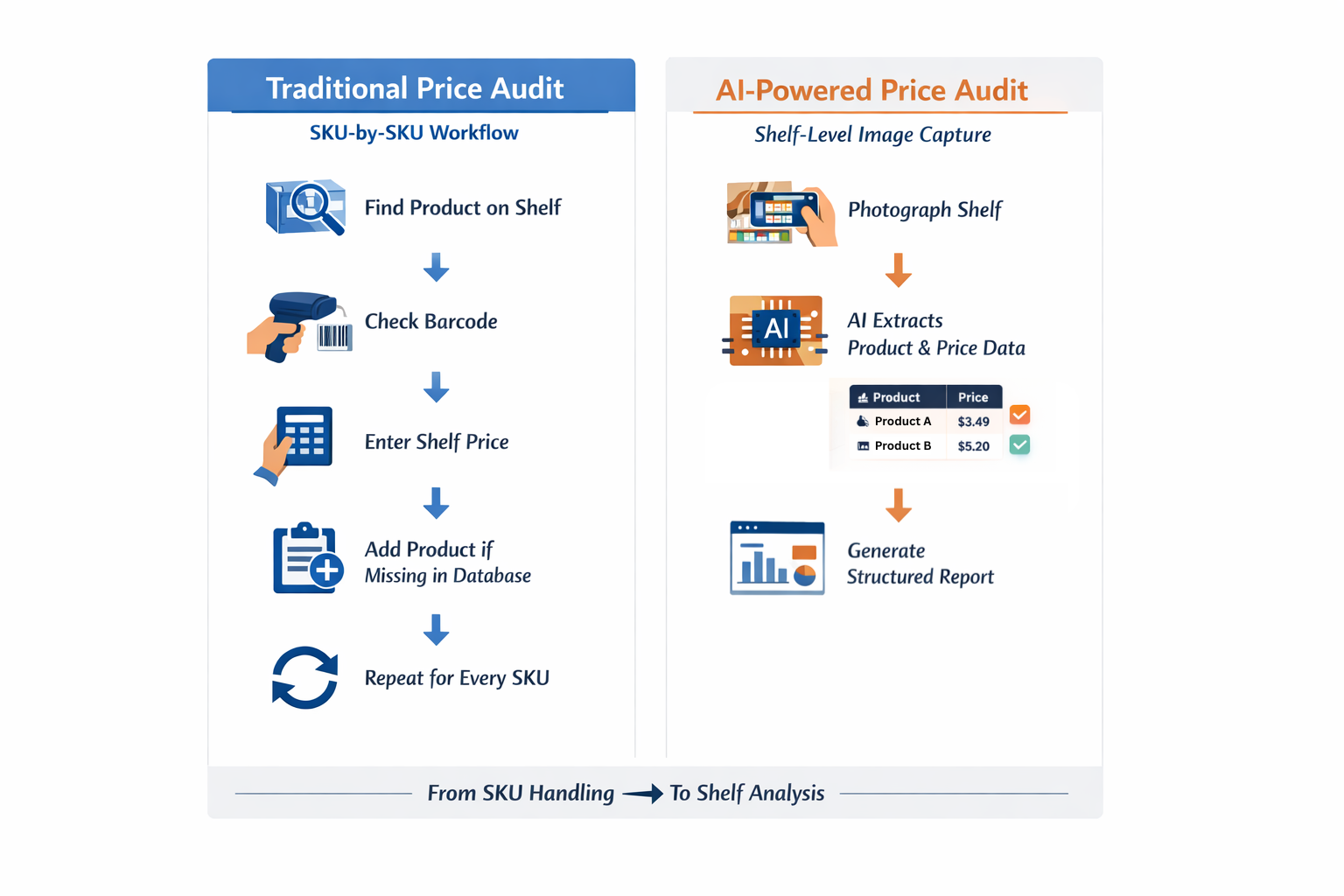
In a conventional price audit, an auditor enters the store with a predefined SKU list and works through it product by product.
For every item, the workflow typically includes:
- Locating the product on the shelf
The auditor must identify the correct variant, confirm pack size, and ensure it matches the SKU list before recording any information. - Handling the product to access its barcode
This often requires physically picking up the item or adjusting shelf placement to scan it correctly. - Scanning and matching the barcode to the system
The product must be linked accurately to an existing database record before price entry can proceed. - Manually entering the displayed price
The shelf price is typed in line by line, introducing time dependency and potential transcription errors. - Creating a new entry if the product is not in the database
When new SKUs appear, full product details must be entered manually before pricing can be recorded.
Each step is logical and controlled. But the process is linear. If the audit expands from 100 SKUs to 200, visit duration increases significantly. Broader coverage requires more time in-store, which requires more labor allocation, and significantly higher cost.
The New Way: Image-Driven Extraction
DataPure changes the unit of work from individual product handling to structured visual capture. Instead of interacting with each SKU separately, auditors:
- Photograph shelf tags directly
A single image captures the displayed price along with visible product identifiers, without requiring item handling. - Capture entire shelf sections in one frame
Multiple SKUs can be documented simultaneously while preserving real shelf context and adjacency. - Collect visual evidence instead of manually entering data
The emphasis shifts from transcription to ensuring complete photographic coverage.
From these images, AI models extract information including:
- Product names and brands
- Pack sizes and visible variants
- Displayed shelf prices
- Promotional prices, where present
Multiple products are processed in parallel rather than sequentially. What previously required repetitive scanning and typing is converted into structured pricing data through visual analysis. The audit shifts from manual documentation to evidence-based capture.
The Business Impact
When documentation is no longer tied to per-SKU handling, the economics of price checks change.
- Higher store coverage within the same timeframe
Reduced entry time allows more locations to be reviewed without expanding field hours. - Broader assortment visibility without extending visit duration
Additional SKUs do not increase audit time at the same rate, enabling deeper category coverage. - More consistent data structuring across locations
Automated extraction applies uniform logic to every image, reducing variability introduced by manual entry. - Lower dependence on proportional labor growth
Expanding coverage or assortment size does not require a corresponding increase in headcount. - Faster turnaround from capture to reporting
Structured pricing data is generated directly from visual evidence, shortening the time between store visit and insight delivery.
Pricing intelligence shifts from being labor-intensive to system-enabled.
Future-Proofing Pricing Visibility
Retail pricing environments demand continuous monitoring. Assortments evolve, promotions change, and competitive positions shift rapidly. Sequential, manual audit models create increasing operational pressure as scale expands.
An image-driven approach changes that structure by converting shelf photography into structured pricing data, thus evolving mystery shopping from a documentation-heavy workflow into a scalable intelligence system. Coverage expands without multiplying complexity. Reporting cycles shorten without sacrificing rigor. When pricing visibility is strategic, the process collecting that visibility must be designed to scale with it.