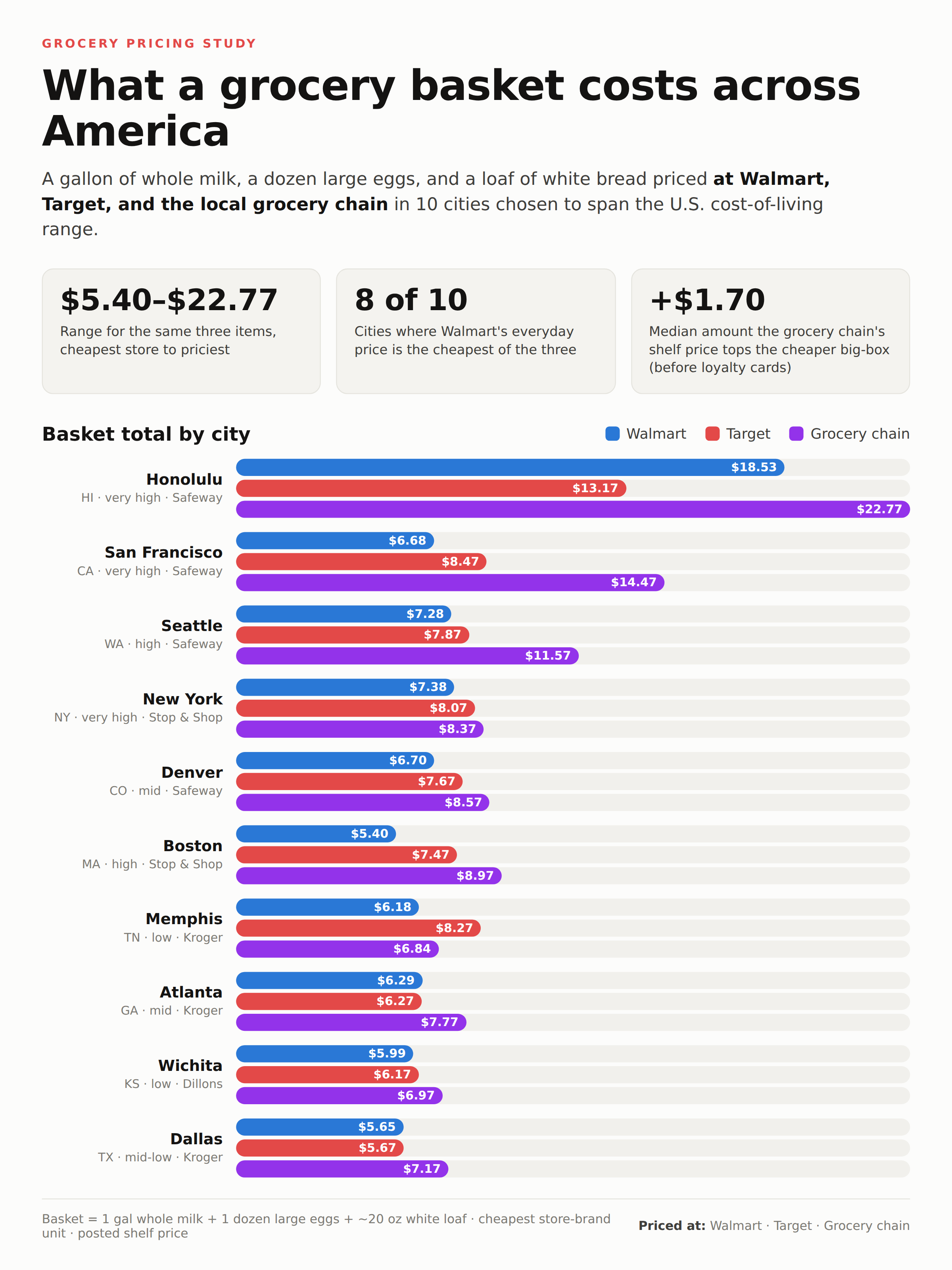
Everyone has a rough sense that groceries cost more in some places than others. But how much more exactly? And does the store you pick matter as much as the city you live in? To find out, we ran a deliberately simple experiment: price the exact same three-item basket - a gallon of whole milk, a dozen large eggs, and a ~20 oz loaf of white bread - at three kinds of store in each of ten ZIP codes chosen to span the American cost-of-living range. The benchmarking includes big boxes, Walmart and Target, and the nearest grocery chain store - Kroger in the South, Safeway out West, Stop & Shop in the Northeast, Dillons on the Plains.
The short answer: Walmart almost always sets the floor, the grocery chain almost always comes in the highest.
Walmart sets the floor; the grocery chain comes in highest
Line the three retailers up city by city and a clear pecking order emerges. Walmart's everyday price is the cheapest basket in eight of the ten cities - Target sneaks under it only slightly in Atlanta and dramatically in Honolulu. And the grocery chain's listed price is the highest of the three in nine of ten, running a median of $1.70 over the cheaper big box. That ordering is almost mechanical: Walmart is built around everyday-low pricing, while the classic grocery chains lean on a high-low model. Which brings us to the single most important caveat in this whole study: the loyalty card.
The loyalty-card asterisk
Every price in this study is a listed shelf price, i.e., what anyone pays with no loyalty card and no clipped coupon. That keeps the comparison fair, because Walmart and Target price these staples the same way for everyone. But the grocery chains don't. Their whole model is a high regular price that a free loyalty card cuts, often steeply: at one Safeway, a dozen eggs were listed at $6.49 rang up at $2.99 with the card. So read the purple bars as an honest ceiling, not as what a card-carrying regular actually pays. For a shopper who bothers to sign up, the grocery chain gap narrows sharply, and sometimes even disappears.
The West Coast is where the gap explodes
The grocery chain premium is not evenly spread. Across the South and Plains the grocery chain premium is about a dollar - in Wichita, Dallas, and Atlanta all three retailers land within roughly $1.50 of one another, a genuine dead heat. But out West, where the grocery chain is Safeway, the visible listed gap grows: the San Francisco grocery chain basket runs $7.79 over the cheaper big box, Seattle $4.29 over. Most of that difference is driven by milk. A gallon at Safeway lists at $6.49 in San Francisco against Walmart's $3.58 and the loyalty card is designed to minimize that gap.
Honolulu is in its own league
Then there's Honolulu, where an island economy that imports nearly everything pushes every basket into a category of its own: Target $13.17, Walmart $18.53, and similarly, the Safeway basket all the way up to $22.77; roughly 3 to 4× the cheapest mainland basket. It's a clear reminder that "national" pricing has limits when the nearest dairy is an ocean away.
Milk is the wildcard
If any single item drives the difference, it is milk. Eggs and bread are nearly uniform across the store-brand lines; milk is where the volatility lives. The grocery chain's own gallon swung from $3.16 in Memphis to $6.49 in San Francisco. Bread and eggs mostly hold a tight national band; milk is the line to watch city to city.
The in-city test
One wrinkle complicates any Walmart comparison: Walmart doesn't operate inside the dense cores of New York, San Francisco, Seattle, or Boston. Its "price" in those cities is really a suburban one, observed from Secaucus, San Leandro, Bellevue, and Saugus, respectively. Target and the neighborhood grocery chain, by contrast, are downtown (or in the nearest borough). That's part of why the grocery chain earns its place here: alongside a suburban Walmart, it puts a real in-city grocery price on the board. And the reassuring news for city dwellers is that the in-city premium on staples is modest. The urban baskets sit only a couple of dollars above the suburban Walmart, not a world apart.
What this means for shoppers?
- Walmart is the reliable floor. If the lowest sticker price is all that matters, it wins almost everywhere - by a little in the South, but by more out West.
- The grocery chain's edge is the shopper card, not the sticker. Its listed price is the highest of the three, but a free loyalty card is doing invisible work; judge it by what rings up, not what's on the shelf tag.
- Geography still rules the extremes. Store brands flatten the map across the mainland; until you hit the West Coast, and then an island, where the same three items cost multiples more.
- Watch milk, not eggs. Eggs and bread barely move; milk carries most of the city-to-city and store-to-store variation.
What this means for retailers?
Retailers must leverage continuous, localized store data to track true competitor pricing and optimize key high-velocity staples like milk that drive consumer price perception. Adjusting prices down to the ZIP-code level on these essential items maintains profitability while protecting the brand's overall affordability image.
- Protect Price Image via Key Value Items (KVIs): Staples like milk, eggs, and bread dictate consumer perception of affordability. Strategic pricing on these low-margin items shapes the overall brand perception.
- Localization over National Standardizing: National pricing strategies create inefficiencies. Regional cost variations, such as an eight-dollar price gap between the South and the West Coast, require hyper-local, ZIP-code-level pricing to optimize both market share and profitability.
- Dual-Price Competitor Tracking: Evaluating a competitor based solely on shelf tags is misleading. Tracking both the regular listed price and the discounted loyalty/member price reveals their actual market positioning.
- Prioritize High-Velocity Signals: Milk experiences the highest volatility and serves as the primary indicator for week-to-week pricing shifts, whereas bread and egg prices require less frequent monitoring.
- Data-Driven Dynamic Tracking: Isolated price checks fail to reveal true market dynamics. Continuous, longitudinal store-level data is essential to setting good-better-best pricing strategies, regional premiums, and actionable competitive trends.
How DataPure can help?
DataPure is an AI-driven data solution that provides automated data pipelines for modern retail intelligence. Our AI technology converts raw in-store inputs, (such as shelf photos, receipts, and tags) into clean, actionable competitive intelligence at scale. We help track regular listed prices, member-only promotional tags, and SKU variations across thousands of stores globally. To continuously track volatile Key Value Items (KVIs) down to the ZIP code level, reach out to us at connect@datapure.ai
How we ran this study? The fine print
We collected prices for the cheapest qualifying store-brand unit of each item at each store: whole-milk gallons (Great Value / Good & Gather / the grocery store's own label), the cheapest dozen large eggs (cage-free where a state requires it; i.e., California, Washington, Colorado, Massachusetts; conventional elsewhere), and the cheapest ~20 oz white loaf. The third retailer in each city is the nearest grocery chain whose in-store shelf tag has been captured, i.e., Kroger, Safeway, Stop & Shop, or Dillons. A few things to note: every figure is a listed, non-member shelf price, so the grocery chain's loyalty-card prices (routinely much lower) are not reflected; this is a single-day snapshot, so promotions, stock, and season will move these numbers; and where a chain has no in-city store (Walmart in several downtowns), the price comes from its nearest location, noted in the full data. This is meant to be a directional read on how geography and store choice shape a simple grocery run, not a precise index.
For the detailed dataset, contact us at connect@datapure.ai